Why blazers look wrong on most people
A blazer is the piece most often bought in the wrong size. Shoppers look at the label, not at the shoulder, and they accept a jacket that pulls across the back because it is the only one in their size. A jacket that fits well changes how the rest of an outfit looks. One that fits badly makes a good shirt look rumpled.
The good news is that the important checks take two minutes and need only a mirror and a window.
Check the shoulder seam first
The shoulder seam is the hardest part to alter, so it matters most. The seam should sit at the edge of your shoulder bone, or very close to it. If the seam drops down your upper arm, the jacket is too big in the shoulder, and no tailor can easily fix that. If the seam pulls up toward your neck, the jacket is too small.
Stand straight, look in the mirror and raise your arms slightly. The fabric should move with you without tugging across the back.
Look at the sleeve length
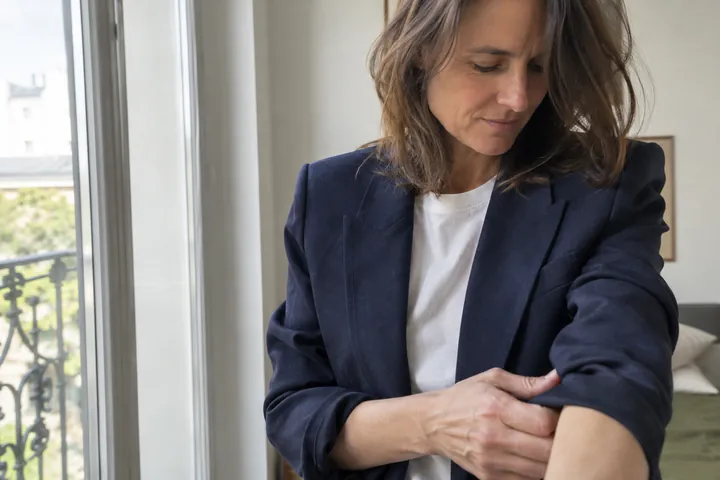
The sleeve should end at the wrist bone, so that a small amount of shirt cuff shows. Too short and the jacket looks like a child's. Too long and it swallows the hand. Bend your elbows and check that the sleeve does not ride up the forearm.
Sleeves are easier to shorten than to lengthen, so a sleeve that is slightly long is often a better buy than one that is short.
Button and close the jacket
A single-breasted blazer should close without strain. If the fabric pulls in an X shape across the button, the jacket is too tight at the waist. If the front falls open easily, it may be too loose, or the cut may be designed to sit open. Check the stance of the buttons. The top button should sit at the natural waist, not above or below it.
Try the jacket with the shirt or the knit you plan to wear under it. Clothes change the fit, and a jacket that works over a thin tee can feel tight over a heavy knit.
Check the length and the back
The hem should cover the seat, and it should lie flat when you stand. Look at the back in the mirror. A clean back has a smooth line from the collar to the hem. Wrinkles that fan out from the armhole mean the jacket is tight in the chest or back.
Test the movement
Reach forward, cross your arms and sit down. The jacket should allow those movements without pulling at the back or shoulders. Watch what happens at the armhole when you reach. If the fabric lifts or the shoulder seam shifts, the jacket will restrict you all day.
Consider the fabric and the lining
Unlined blazers are soft and easy to wear, but they show wrinkles and need a shirt beneath them. Lined blazers hold their shape better and are often more formal. Fabric weight matters too. A light wool or a cotton blend suits warm weather, while a heavier wool keeps its line in cooler months.
Pull the fabric at the elbows and the back. Good fabric springs back quickly. If it stays creased, it will look worn after a few wears.
When to alter and when to walk away
Sleeve length, hem length and waist can usually be altered by a competent tailor. Shoulder width and the overall cut are much harder to change. If the shoulder is wrong, put the jacket back and look for another cut.
The checklist below gives you a score and a plain recommendation based on the points above. Use it in the shop, with the jacket on.
Blazer fit check
Interactive toolTry the blazer on, then tick each point that is right. Eight points out of eight means the fit works.
Loading the result. The guide above works without this tool.
A note on styling
Once the fit is right, the styling becomes simple. A navy blazer works over a white tee, a knit or a silk shell. Keep the trousers or skirt in a neutral tone so the jacket remains the focus.
A blazer that fits well looks expensive even when it is not. The fit does more than any label.
Frequently asked questions
Should a blazer be tight or loose?
Close to the body at the shoulder and chest, with room to move. It should look fitted when you stand still and still allow you to reach and sit.
Can a tailor fix a blazer that is too big?
A tailor can usually take in the body and shorten the sleeves. Reducing the shoulder width is much harder, so check the shoulder first.
How long should the sleeves be?
To the wrist bone, so a small amount of shirt cuff shows when your arms are relaxed.
Is it worth buying a blazer online?
Yes, if the store has clear size charts and an easy return policy. Measure a jacket you already like and compare the shoulder and sleeve measurements before you order.